SBR - Sequencing Batch Reactor Systems for Wastewater Treatment
SBR - Sequencing Batch Reactor technology is well known for its simplicity and low cost. It has been widely used for municipal and industrial wastewater treatment applications to meet specific effluent requirements.
Sequencing Batch Reactor System is a fill and draw Activated Sludge System. SBR process uses high-efficiency oxygen transfer aeration equipment to satisfy the high-rate oxygen consumption requirement at the beginning of the "fill" and "aeration" cycles. SBR is efficient in carbonaceous pollutant removal, and is easily modified to satisfy nutrient removal of nitrogen (N) and phosphorous (P). Because the fill, aeration, settlement and and draw take place in the same reaction tank, thus SBR tank itself also serves as the clarifier itself.
Sequencing Batch Reactor (SBR) Technology Advantages/Benefits
- Lower installed cost than "Conventional" methods
- Less land space required for SBR treatment plants
- Consistent high-quality, low nutrient level effluent
- Tolerates wide swings in flow and organic loading
- No clarifier required
- Better control over filamentous growth and settling problems
- Nutrient removal without chemicals - nitrification and denitrification, phosphate removal
- Simple sludge process management
- Less equipment to service and maintain
- Existing plants can often be converted to SBR process
- Less operator attention than "Conventional" processes
Wastewater Engineering Group provides Sequencing Batch Reactor wastewater treatment plant and process design services, consulting, retroffing and
- SBR Plant Design
- SBR Process Design
- Pilot Test
- Startup and Commissioning
- Equipment Supply and Servicing
Open the full-size sbr flow diagram ↗
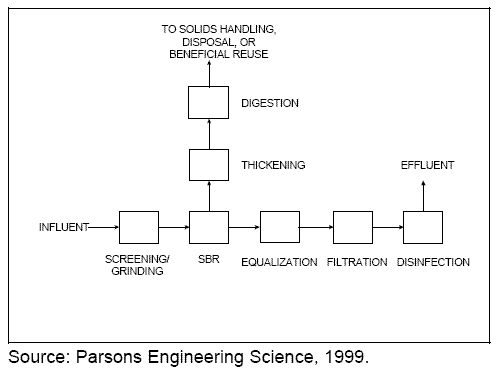
A process flow diagram of a typical SBR system is as shown above. The headworks process is similar to that of activated sludge process, influent storage or equalization may not be required since the SBR tank itself can serve as a buffer tank and is able to take some kind of shock loadings. Sludge treatment processes are similar to that of a activated sludge system. However the treated effluent may need to be equalized to ensure the effluent quality is suitable for disposal or for further advanced treatment.
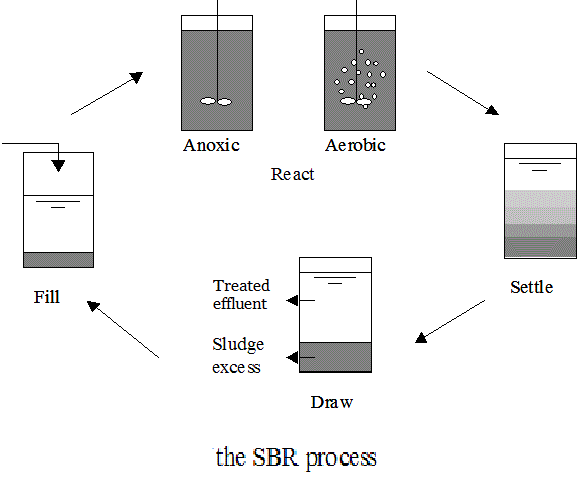
The processes inside the Sequencing Batch Reactor system include the following:
- Fill - raw sewage or wastewater is filled into the SBR tank, can be mixed, or aerated
- React - aeration process for the carbonanceous organic pollutant removal
- Settlement - settling of sludge after the react
- Draw - the supernatant is decanted (withdrawn) from the tank for discharge or further treatment
Open the full-size sbr process diagram ↗
Some major equipment used in Sequencing Batch Reactor System are:
- Pretreatment equipment: bar rakes, coarse and fine screens
- Fine bubble aeration systems: air blowers and diffusers
- Pumps for raw wastewater and treated effluent pumping
- SBR Decanters for drawing of supernatant from the tank after settlement
- Effluent disinfection systems
Wastewater Engineering Group offers integrated SBR wastewater treatment plants /facility and process design, planning, for sewage disposal and water reuse.
Current SBR engineering notes
Reviewed October 2026. An SBR remains a fill-and-draw activated-sludge process in which timing and control coordinate fill, react, settle, draw, and idle phases. Its flexibility comes from changing the operating sequence; that flexibility also makes reliable instrumentation, valves, decanters, level control, and operator response important design elements. The historical cycle diagrams and article remain retained above.
| Decision area | Current design question | What to verify |
|---|---|---|
| Cycle and capacity | Can the selected number of basins and cycles per day handle average, peak, seasonal, and maintenance conditions? | Flow pattern, decant volume, cycle time, idle allowance, equalization, and one-basin-out resilience. |
| Biological sequence | Which fill and react modes are needed for carbon removal, nitrification, denitrification, or biological phosphorus removal? | Ammonia, nitrate, COD fractions, alkalinity, temperature, DO/ORP control, and sludge age. |
| Settling and draw | Will settling produce a clear decant without floating or settled sludge carryover? | Settle tests, sludge volume, decanter withdrawal rate, scum control, and draw-level protection. |
| Controls and maintenance | Can the automation system detect and safely manage sensor, valve, blower, decanter, or power failures? | Instrument redundancy, fail-safe positions, manual overrides, alarms, spare parts, and restart logic. |
| Downstream treatment | Does the variable batch discharge need equalization, filtration, disinfection, or nutrient polishing? | Effluent variability, peak discharge, residual solids, permit limits, reuse barriers, and receiving-water requirements. |
SBR selection boundary
SBR can fit municipal or industrial applications where batch operation, footprint, and sequence control align with the influent pattern and effluent limits. The process should not be selected from cycle timing alone: site-specific influent and effluent characterization, temperature, peak factors, treatability, automation, and maintenance capability determine the viable sequence. EPA’s Sequencing Batch Reactors Technology Fact Sheet identifies the fill-and-draw cycle, advantages, disadvantages, and key design criteria.