
MBBR - Moving Bed Biofilm Reactors for Wastewater Treatment
MBBR - Moving Bed Biofilm Reactor is derived from the Conventional Activated Sludge Process. It utilizes suspended growth activated sludge process and fluidized attached growth biofilm system.
Packing media (carriers) with large surface area is used in aeration tanks and biofilm growth will take place around and inside the packing materials. Due to the large surface area provided by the suspended packing media, the MBBR process is able to take higher BOD/COD loading.
The following is a MBBR Design Schematic Process Flow Diagram (PFD), or Piping & Instrumentation Diagram (P&ID) Open the full-size MBBR process flow diagram ↗
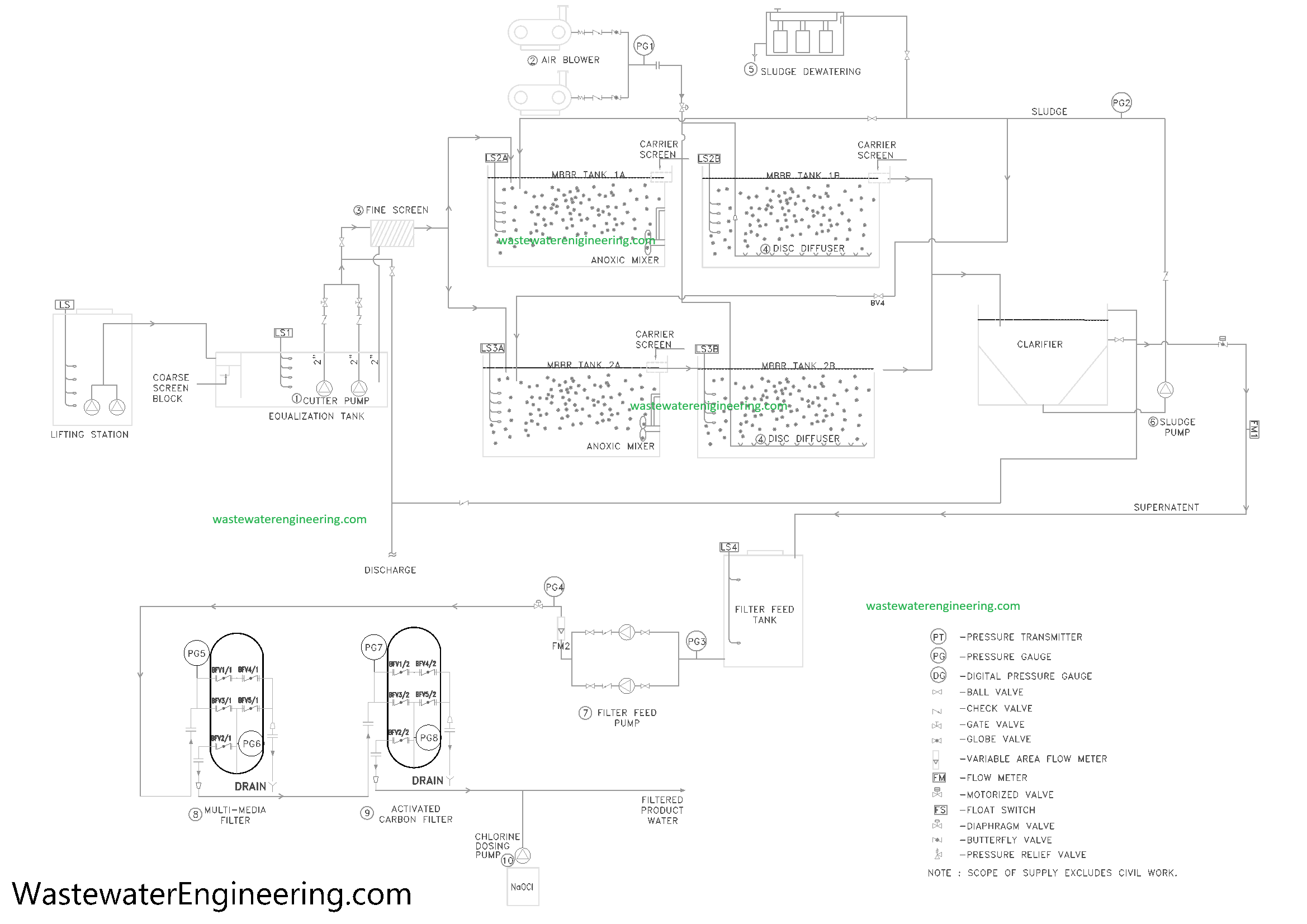
MBBR technology is a good choice for upgrading/retrofitting existing activated sludge plants to achieve higher capaicity and better effluent quality.
To prevent the suspended packing used in the MBBR reactors from going into the downstream clarifiers, screens are usually required at the exit to the clarifier. Air-lift pumps may also be used to recirculate the suspended packings back to the front section of the reactor.
The advantages of MBBR is it increased the BOD and COD loading in the same reaction tanks. It also has same flexibility to add Denitrification and even Anaerobic functions for nutrient removal. However the disadvantage is its final effluent quality is still much dependant on the settling tanks downstream. Thus it is usually necessary to add post-treatment using filters to polishing the treated water if reuse is required.
Current MBBR engineering notes
Reviewed October 2026. MBBR is an attached-growth process that uses suspended carrier media in a mixed and, commonly, aerated reactor. The process can support capacity upgrades and staged carbon or nitrogen treatment, but the outcome depends on media retention, protected surface area, oxygen transfer, mixing, solids separation, and the actual wastewater matrix. The historical process-flow diagram and article remain retained above.
| Decision area | Current design question | What to verify |
|---|---|---|
| Media and retention | Is the selected carrier volume, protected surface area, fill arrangement, and retention screen suited to the duty? | Carrier geometry, media movement, screen passage, abrasion, inspection access, and replacement strategy. |
| Oxygen and mixing | Can the aeration and mixing system keep media moving while meeting carbon-removal or nitrification demand? | Oxygen-transfer tests, basin hydraulics, diffuser fouling, low-load operation, and peak-load conditions. |
| Nutrient removal | Are anoxic or anaerobic zones, recycle, carbon availability, and alkalinity adequate for the target limits? | COD fractionation, ammonia and nitrate loads, internal recycle, temperature, and phosphorus objectives. |
| Solids separation | How will detached biofilm and suspended solids be separated after the carrier reactors? | Clarifier or filtration loading, sludge wasting, washout protection, and wet-weather performance. |
| Retrofit fit | Can existing tanks, hydraulics, screens, blowers, access, and downstream treatment accept the media process? | Hydraulic profile, structural loading, screen maintenance, electrical capacity, and construction phasing. |
MBBR selection boundary
MBBR is often screened for biological intensification or retrofit work where attached growth can add treatment capacity within existing basins. It is not a universal replacement for solids separation or polishing: the complete train must be checked for effluent TSS, nutrient limits, toxicity, salinity, temperature, and shock loads. EPA’s Emerging Technologies for Wastewater Treatment and In-Plant Wet Weather Management lists MBBR among established biofilm processes and should be read alongside project-specific treatability and design data.