
Counter Flow Reverse Osmosis (CFRO) Systems
Around the Osmosis basis, variations of different types of systems have been developed in the market. The diagram below shows a few common types.
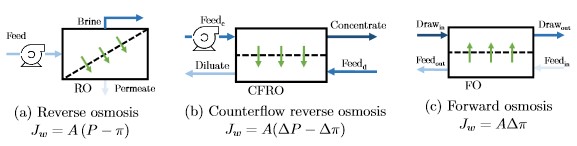
Counterflow Reverse Osmosis (CFRO) is a process which adds a counter flow on the permeate side of the RO membrane, to reduce the osmotic pressure on the permeate side to reduce the net driving pressure required for the permeate to flow from the feed/concentrate to the permeate side. Thus it doesn't need to add pressure on the feed pump used in normal RO System.
At its core, CFRO is a membrane-based, pressure driven brine concentration technol- ogy, which shares many properties with other membrane-based chemical separation technologies, such as RO and FO. Like RO, permeate flows from the side of high concentration and high hydraulic pressure, across the membrane, to the side of low concentration and low hydraulic pressure. However, unlike RO, CFRO employs two feed streams instead of one. The first feed stream, which is referred to as the con- centrate stream, is analogous to the feed stream in an RO system. The concentrate stream is dewatered as permeate flows through the semi-permeable, salt-rejecting membrane, and leaves the module with a reduced mass flow rate and increased con- centration. On the opposite side of the membrane is another saline feed stream, which we call the diluate stream. This stream is diluted as permeate flows through the membrane, and the stream leaves the module with increased mass flow rate and reduced concentration.
CFRO process is suitable to be applied when zero liquid discharge is required, because the brine side can achieve TDS up to 260,000 mg/L. This process also increases the recovery ratio compared to typical Reverse Osmosis process.
The downside of this process is the complicated control to maintain the flow and pressure balance within the stages.
Although the CFRO process helped to achieve higher recovery ratio and higher concentration on the brine side using high pressure pumps and pressure vessels same as RO systems, the overall energy requirement to produce each cubic meter of permeate water is high. The capital investment is also very high.
CFRO flow-diagram variations
The following configuration diagrams supplement the established CFRO overview. They illustrate possible feed, recycle, permeate, diluate, concentrate, and energy-recovery relationships; they are not construction drawings or universal operating prescriptions.
Single-Stage CFRO with Energy-Recovery Device Flow Diagram

Split-Feed CFRO Configuration with One RO and Two CFRO Stages

Split-Feed CFRO Configuration with Intermediate Feed before CFRO

Current CFRO development directions
Current CFRO development is increasingly focused on integrating the process with complementary treatment steps rather than treating it as a stand-alone recovery solution. The most promising directions below are engineering and research opportunities; their suitability depends on feed salinity, pressure, membrane compatibility, energy balance, concentrate chemistry, and the required water-recovery target.
Hybridization with RO for higher overall recovery
Hybrid CFRO–RO trains can distribute concentration work between conventional reverse osmosis and counter-flow stages. An RO step may provide an efficient front-end recovery or polishing duty, while CFRO can be considered where rising osmotic pressure makes further conventional RO concentration difficult. The objective is not to assume that CFRO always improves a train, but to optimize the combined pressure, recovery, energy, and residuals balance.
Integration with evaporation for MLD and ZLD
CFRO can be evaluated as a pre-concentration step ahead of evaporation technologies in minimum-liquid-discharge (MLD) or zero-liquid-discharge (ZLD) schemes. By reducing the liquid volume entering thermal treatment, a hybrid train may shift more of the work toward membranes before evaporation. The design must still account for scaling, crystallization, heat demand, brine composition, solids handling, and the total lifecycle cost of the combined system.
Membrane and module configuration breakthroughs
Further progress may come from membrane and module development across hollow-fiber RO/FO concepts and spiral-wound or plate-form flat-sheet RO/FO configurations. Relevant research areas include selective-layer chemistry, support and spacer design, pressure-vessel hydraulics, sealing, concentration-polarization control, cleanability, and materials that tolerate high salinity and repeated pressure cycling. These are development pathways rather than established universal replacements for current CFRO modules.
Process and equipment co-design
The strongest improvements are likely to come from co-designing membrane selection, module geometry, pumps, energy-recovery equipment, controls, pretreatment, and concentrate management as one treatment train. Demonstration under representative feed conditions should verify recovery, specific energy consumption, membrane life, cleaning frequency, salt passage, and residuals performance before scale-up.