
What DTRO is — and what it is not
Disc-tube reverse osmosis (DTRO, also written DT-RO) is a high-pressure reverse-osmosis configuration, not a different fundamental separation mechanism. Like other RO systems, it produces treated permeate and a more concentrated retentate. DTRO can improve permeate quality and reduce liquid volume, but it does not destroy contaminants or eliminate the need to manage the concentrate. [1] [4]
The term describes a module arrangement built from alternating hydraulic discs and membrane cushions. Published descriptions emphasize open feed channels, short hydraulic paths, and repeated flow-direction changes intended to increase local turbulence and reduce the vulnerability that tightly packed modules can have to deposition and biofouling in difficult feeds. [1] [5]
Engineering principle: select DTRO as part of a complete treatment train—considering feed chemistry, pretreatment, operating pressure and recovery, cleaning, permeate endpoint, and the final concentrate route.
Where DTRO can fit in a treatment train
DTRO is most relevant where conventional RO configurations may be difficult to operate because feed is variable, saline, organically loaded, scale-forming, biologically active, or carries residual suspended matter after upstream treatment. It is commonly discussed for landfill leachate and selected hypersaline or industrial concentration duties. A 2021 review identified leachate and flue-gas-desulfurization wastewater as the most frequently reported DTRO applications in the literature it assessed. [1]
| Treatment role | Typical purpose | Required engineering question |
|---|---|---|
| Post-treatment or polishing | Produce high-quality permeate after biological, physicochemical, or membrane pretreatment. | Does pretreatment consistently control solids, organics, scale-formers, and feed variability? |
| Concentration / volume reduction | Reduce liquid volume and concentrate retained salts, organics, nutrients, or other constituents. | Is there a safe, permitted, and viable route for the concentrate? |
| Multistage recovery | Use more than one membrane stage to recover additional water or refine permeate quality. | Do recovery and quality gains justify pressure, energy, cleaning, and residual-management demands? |
| Modular response treatment | Address variable or remote sidestreams where a modular membrane plant may be practical. | Are equalization, utilities, chemical handling, residual storage, and operator support adequate for stable operation? |
How the process works
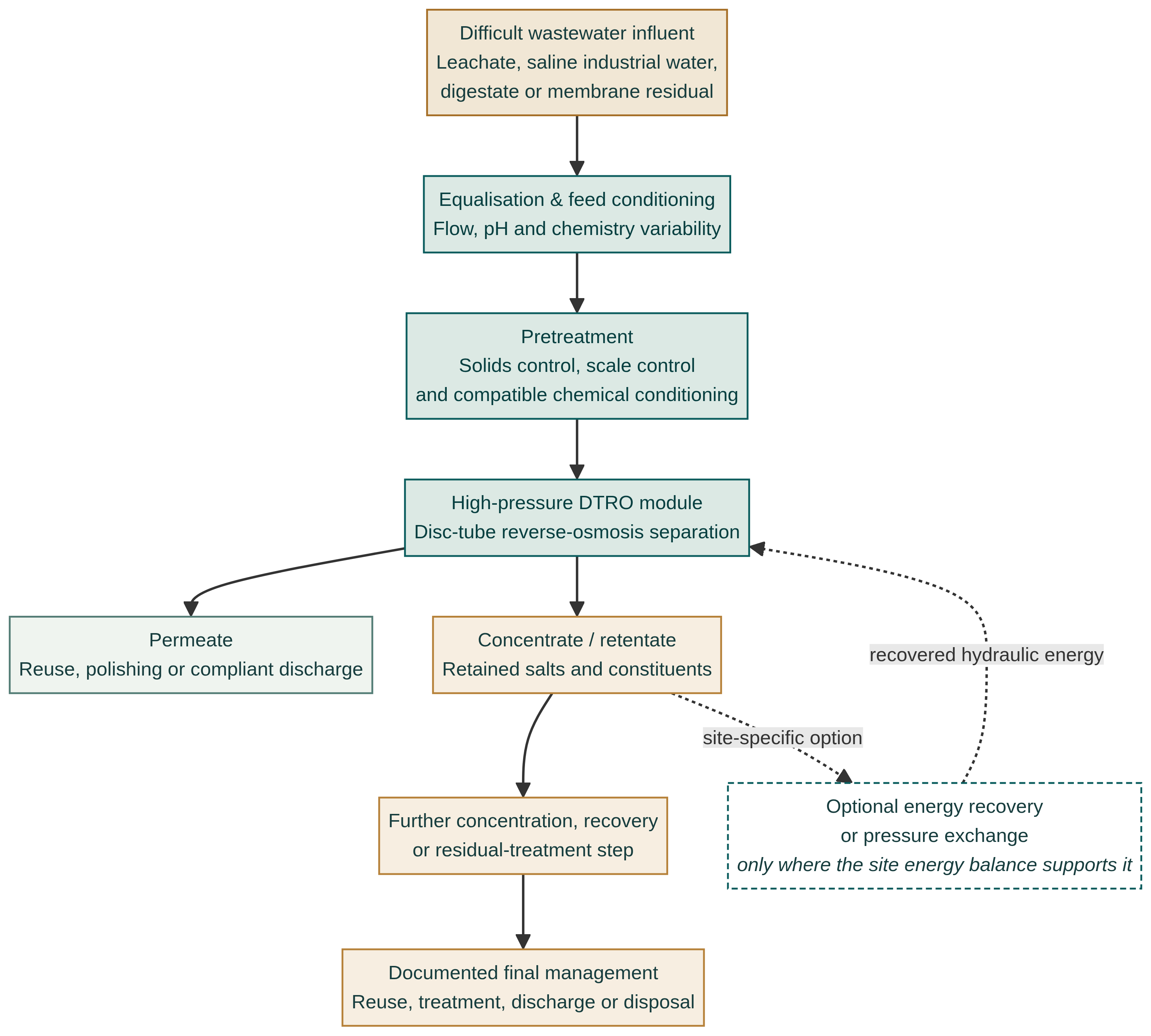
DTRO applies pressure greater than the feed’s effective osmotic pressure to drive water through an RO membrane. Permeate moves to the collection pathway while rejected salts and other retained constituents remain in a concentrate stream. As recovery increases, retained constituents become more concentrated, osmotic pressure rises, and the available driving force for permeation narrows. These constraints are central to sizing, staging, pressure selection, cleaning, and concentrate management. [2] [4]
In a published pilot treating pretreated landfill leachate, DTRO operated at approximately 21–76 bar with 7.1–32.5 L·m−2·h−1 permeate flux. Two stages exceeded 91% water recovery in that specific system; a third stage was used to address the reported boron objective. This is useful multistage evidence, not a universal performance guarantee. [2]
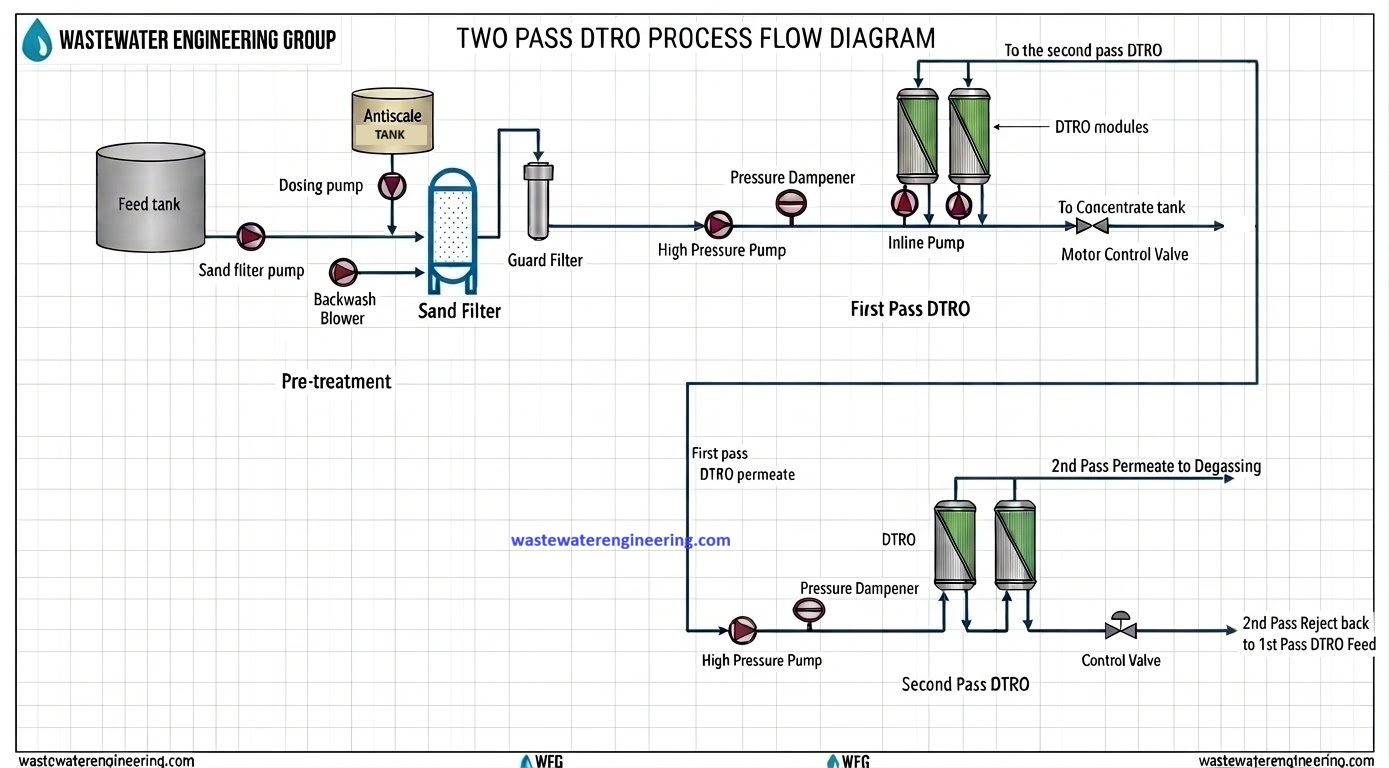
DTRO Process Flow Diagram
Two Pass DTRO Process Flow Diagram
Open the full-size two-pass DTRO process flow diagram ↗
DTRO compared with standard reverse osmosis
In this table, standard RO means a conventional spiral-wound RO arrangement. Both systems use the same pressure-driven separation principle; the meaningful differences are module hydraulics, packing density, feed tolerance, cleaning approach, and the treatment-train context. The table is a selection aid, not a universal performance ranking. [1] [5]
| Comparison point | DTRO | Standard spiral-wound RO | Engineering implication |
|---|---|---|---|
| Module and flow-channel geometry | Uses disc-and-cushion elements with open hydraulic channels, short flow paths, and repeated direction changes. | Commonly uses tightly packed membrane leaves and spacer-filled feed channels within a spiral-wound element. | DTRO’s more open geometry can be advantageous for selected difficult feeds; spiral-wound modules generally provide a more compact membrane area per element. [5] |
| Typical feed fit | Often considered for challenging, variable, high-strength, saline, scale-forming, or biologically active wastewater after suitable pretreatment. | Widely used for more consistently conditioned brackish-water, potable-reuse, industrial, and wastewater-polishing duties. | The selection should start with feed variability, pretreatment reliability, and operating objectives—not with a presumed universal “best” module. [1] |
| Fouling and solids tolerance | Open channels and high-shear flow may offer a more tolerant operating geometry for selected foulants and residual particulates. | Spacer-filled channels can be more sensitive to deposition where solids control or pretreatment is inadequate. | DTRO may be preferable when the matrix is difficult, but neither configuration is fouling-free and both need matrix-appropriate pretreatment and cleaning. [5] |
| Pressure and recovery | Can be configured for high-pressure concentration and multistage recovery in suitable applications. | Offers broad operating flexibility and is routinely staged for water recovery and permeate quality. | Higher pressure or recovery increases energy, scaling, and concentrate-management demands in either arrangement. [2] [4] |
| Cleaning and maintainability | Designed for chemical-cleaning access and operation with difficult streams; cleaning strategy remains a central operating requirement. | Well-established cleaning methods, but fouling or scale in packed feed spacers can materially affect normalized performance. | Compare cleaning frequency, chemical compatibility, downtime, waste-cleaning solution handling, and recovery of normalized permeability over the actual operating cycle. [2] [3] |
| Footprint and module economics | May require more module volume or capital per unit membrane area because of the more open configuration. | Generally benefits from high membrane packing density and broad supply-chain familiarity. | DTRO’s hydraulic robustness can justify the trade-off for a difficult feed; a conventional arrangement can be advantageous where the feed is stable and compactness is the priority. The historic comparison is not current cost data. [5] |
| Energy-efficiency pathways | Can be evaluated with staging, energy recovery, and potential batch or closed-circuit operating concepts. | Can likewise use staging, energy recovery, and time-varying RO concepts where the pressure, salinity, and flow regime support them. | Energy-saving methods must be tested as a system. Published batch/closed-circuit RO evidence is not DTRO-specific and should not be treated as a guaranteed DTRO benefit. [7] [8] |
| Concentrate management | Produces a concentrate that may be further reduced or managed downstream. | Also produces a concentrate that needs a documented treatment, reuse, discharge, or disposal route. | Concentrate planning is a shared design obligation; front-end recovery should be set only after the residual route is credible. [4] |
Applications and suitability
| Stream or setting | Why DTRO may be considered | Important limits and cautions |
|---|---|---|
| Landfill leachate | Leachate may have high salinity, refractory organics, ammonia, metals, and seasonal variability. DTRO has been used after upstream biological and solids-removal processes. [1] [2] [3] | Cleaning, scale control, compatible pretreatment, and a credible concentrate destination are essential. |
| Hypersaline industrial wastewater / FGD wastewater | DTRO can act as a concentration step where high salt loading makes recovery and volume reduction the main goal. [1] | High osmotic pressure, inorganic scale, material compatibility, power demand, and downstream brine management can govern feasibility. |
| Liquid digestate | DTRO can reduce volume and retain nutrient-rich constituents, potentially improving storage and transport logistics before another management decision. [6] | Concentration is not the same as producing an approved fertilizer product. Nutrients, salts, pathogens, metals, organics, and regulatory conditions must be assessed for the intended end use. |
| Complex industrial or hazardous sidestreams | The more open hydraulic configuration may be considered where biological activity, colloids, metals, or organics create an elevated fouling challenge. [1] [5] | Pilot testing, chemistry compatibility, residual classification, and discharge obligations are stream specific. |
| RO concentrate or residual-volume reduction | DTRO may further recover water or produce a smaller concentrate for a final management process. | Every additional concentration step increases scaling, osmotic-pressure, energy, and disposal challenges. |
Documented performance: how to read it responsibly
Published studies demonstrate strong contaminant removal and water recovery in defined DTRO systems, while also showing that results are tied to the feed matrix and treatment train.
| Evidence source | Reported context | Appropriate conclusion |
|---|---|---|
| Liu et al. (2008) | A full-scale DT-RO landfill-leachate system reported stable first-six-month operation, high removal of COD, TOC, conductivity, ammonia-nitrogen, and selected divalent ions; the authors highlighted chemical cleaning. [3] | DTRO can be effective in a defined full-scale leachate treatment train; cleaning and raw-water quality remain central. |
| Cingolani et al. (2018) | A pilot three-stage DTRO system followed UF-assisted activated sludge and reported matrix- and stage-dependent removal values, recovery above 91% in two stages, and an additional stage for its boron objective. [2] | Evaluate recovery and permeate quality together and use a defined monitoring and cleaning approach. |
| Zhang et al. (2021) | A review summarized 46 full-scale and 17 pilot DTRO applications in China by 2020, with leachate and FGD wastewater common among the assessed studies. [1] | DTRO has a meaningful published application base, but performance and cost ranges are geographically and matrix specific. |
| Gong et al. (2013) | A year-long digestate pilot reported a concentration factor of four at 45–55 bar and combined organic/inorganic fouling. [6] | DTRO can support volume reduction in selected digestates, but fouling control and the intended fate of the concentrate govern its value. |
Advantages
The case for DTRO is not that it makes fouling disappear. Its module hydraulics can instead provide a more tolerant operating geometry for selected difficult feeds than some tightly packed conventional RO elements. A historic controlled comparison with bacteria- and metal-containing simulants found smaller normalized flux and salt-separation losses for the tested disc-tube module than its comparator spiral-wound unit; the authors also described lower membrane area and higher element cost in that comparison. [5]
| Potential advantage | Practical significance | Boundary of the claim |
|---|---|---|
| Open-channel, high-shear hydraulic environment | May help manage feeds with residual particulates, bioactivity, or foulants that create operating difficulty in spacer-filled channels. | It does not remove the need for solids control, pretreatment, cleaning, or conservative recovery limits. |
| Suitability for high-pressure operation | Can support streams with elevated salinity and osmotic pressure where additional driving force is needed. | Pressure increases energy use, mechanical duty, safety requirements, and does not solve scaling or concentrate disposal. |
| Multistage flexibility | Staging can separate recovery and later permeate-polishing objectives. [2] | More stages add pumps, controls, cleaning needs, capital, and potential performance losses as residuals concentrate. |
| Potentially recoverable concentrate value | Concentration can support nutrient management, crystallization, or downstream recovery concepts in selected streams. | A concentrate is not automatically a usable product; testing, conditioning, regulation, and offtake remain decisive. |
Limitations and trade-offs
Fouling and scaling still govern reliability
DTRO remains subject to organic fouling, biological growth, colloidal deposition, inorganic scale, and membrane compaction or ageing. Feed water, recovery, temperature, pH, coagulant carry-over, calcium, sulfate, silica, organics, and operating conditions can all matter. Studies of landfill leachate and digestate identify cleaning and mixed inorganic-organic fouling as practical constraints. [2] [3] [6]
Energy and hydraulic duty can be material
Treating saline or concentrated streams requires high pressure. As recovery rises, the concentrate becomes more saline and pressure and energy demand can increase. Evaluate specific energy, recovery, chemical use, membrane life, concentrate cost, and treated-water value together rather than relying on a single removal percentage. [1] [2]
Concentrate is a design output, not an afterthought
Every RO system produces concentrate. In landfill-leachate treatment, final concentrate management can be a major sustainability and cost constraint; recirculation may create pollutant-accumulation risks and should not be presumed acceptable without site-specific assessment. [2] [4]
Operating and design considerations
| Design or operating question | Recommended engineering response |
|---|---|
| Is the feed characterized across time? | Sample more than one condition and include conductivity/TDS, COD/TOC, suspended solids, pH, alkalinity, hardness, silica, iron, ammonia, target constituents, temperature, and variability where relevant. |
| What pretreatment is required? | Evaluate equalization, solids separation, coagulation or clarification, biological treatment, media filtration, UF/MF, pH adjustment, scale control, and cartridge protection from the actual stream. |
| How will recovery be controlled? | Define conservative initial recovery, pressure, flux, and concentrate-bleed settings, then optimize with performance data and a secure residual route. |
| How will membrane condition be monitored? | Trend normalized permeate flow or permeability, pressure, conductivity or salt passage, recovery, differential pressure, cleaning response, and feed-quality indicators. Relating osmotic-pressure and pressure conditions to permeability decline can support maintenance decisions. [2] |
| What cleaning strategy is feasible? | Establish compatible acid/alkali cleaning chemistry, triggers, rinse and waste handling, safety controls, and verification of performance recovery. |
| Where does concentrate go? | Document storage, transport, treatment, recovery, discharge, reuse, or disposal; quantify expected mass and volume under normal and upset conditions. |
Improvement opportunities
DTRO improvement should be treated as treatment-train optimization, not simply as a search for higher operating pressure.
| Improvement area | Why it matters | Practical direction |
|---|---|---|
| Feed equalization and targeted pretreatment | Influent variability and scale-forming or foulant loads can dominate membrane stability. | Use matrix-specific pilot work to set solids removal, pH, chemical conditioning, and biological or oxidative pretreatment. |
| Stage-specific recovery and permeate routing | The optimum recovery stage may differ from the final permeate-quality stage. | Evaluate staged concentration and a separate polishing/refinement pass where the treated-water objective warrants it. [2] |
| Condition-based cleaning and control | Fixed schedules can clean too early or allow avoidable irreversible fouling. | Use normalized permeability, pressure, conductivity, flux, and feed chemistry as intervention signals. |
| Energy recovery and pressure-exchange integration | High-pressure concentrate can retain hydraulic energy that may be transferred back to the feed. Viable benefit depends on pressure, concentrate flow, salinity, recovery, equipment efficiency, and control losses. [8] | Screen energy-recovery devices and pressure-exchange arrangements as part of a system energy balance; do not assume a benefit for low-pressure or low-concentrate-flow DTRO duties without a project-specific calculation. |
| Batch or closed-circuit operating modes | Time-varying RO can reduce avoidable driving-pressure variation and improve modeled energy efficiency at suitable salinity and recovery conditions. The research is not DTRO-specific. [7] [8] | Assess batch or closed-circuit recirculation in a representative pilot, including DTRO module hydraulics, cycle timing, scale control, cleaning, control complexity, permeate quality, and concentrate management. |
| Novel membrane and module configuration development | Improved membrane materials, fouling-resistant surfaces, disc support geometry, flow distribution, packing density, and cleanability could reduce lifecycle trade-offs. Long-duration, independently comparable DTRO evidence remains limited. [1] [5] | Treat novel membranes and module configurations as an R&D pathway. Require realistic matrix testing, compatibility review, cleaning and ageing evidence, pressure-vessel safety assessment, and comparison with established modules before scale-up. |
| Concentrate minimization and resource-oriented management | The residual route often controls lifecycle feasibility. | Compare further concentration, selective recovery, thermal treatment, permitted off-site management, or other routes before finalizing front-end recovery. |
| Long-term evidence and lifecycle assessment | DTRO evidence includes many applications but fewer long-duration, independently comparable datasets across matrices. [1] | Require representative pilot operation, foulant analysis where needed, chemical and energy accounting, and a full residuals mass balance. |
A practical selection framework
- Define the objective. Establish whether the priority is discharge compliance, reuse water, volume reduction, contaminant isolation, nutrient concentration, or a combination.
- Characterize the complete stream. Do not select a membrane configuration from TDS or COD alone; determine solids, scale potential, organics, target constituents, temperature, and variability.
- Compare DTRO with alternatives. Compare conventional spiral-wound RO, NF, tubular systems, pretreatment upgrades, evaporation, membrane distillation, and non-membrane pathways where relevant.
- Design the residual route early enough to inform recovery. The recovery target must be compatible with concentrate storage, transport, treatment, reuse, discharge, or disposal.
- Pilot under representative conditions. Include variability, cleaning, recovery limits, permeate quality, energy, and concentrate characterization—not only a short-term removal result.
- Use a lifecycle decision metric. Compare water quality, uptime, chemical use, energy, membrane replacement, labour, concentrate management, and environmental obligations.
Technology maturity at a glance
DTRO has a documented application history in leachate treatment and selected concentration duties. Its strongest case is generally where feed conditions are difficult enough that disc-tube hydraulics offer a practical reliability advantage. It is not a universal replacement for conventional RO and should not be described as fouling-free, zero-discharge, or best available without stream-specific evaluation, a defined residual route, and evidence appropriate to the regulatory objective. [1] [2] [4] [5]
Related engineering resources
For connected context, explore reverse osmosis systems, wastewater treatment services, and industrial wastewater services. For a project-specific discussion, use our Contact us page. This article is an educational overview, not a design specification, regulatory determination, or guarantee of treatment performance.
References
- Zhang, Z. et al., Application of disk tube reverse osmosis in wastewater treatment: A review, Science of the Total Environment, 2021
- Cingolani, D. et al., Pilot-scale multi-stage reverse osmosis (DT-RO) for water recovery from landfill leachate, Waste Management, 2018
- Liu, Y. et al., Performance of landfill leachate treatment system with disc-tube reverse osmosis units, 2008
- de Almeida, R. et al., A review on membrane concentrate management from landfill leachate treatment plants, 2022
- Siler, J. L., A Comparison of ROChem Reverse Osmosis and Spiral-Wound Reverse Osmosis Membrane Modules, U.S. Department of Energy report WSRC-RP-92-239, 1992
- Gong, H. et al., Concentrating process of liquid digestate by disk tube-reverse osmosis system, Desalination, 2013
- Warsinger, D. M. et al., Energy efficiency of batch and semi-batch (CCRO) reverse osmosis desalination, Water Research, 2016
- Wei, X. et al., Reclaiming wastewater with increasing salinity for potable water reuse, Desalination, 2021