AGS - Aerobic Granular Sludge Technology
AGS - Aerobic Granular Sludge technology is an innovative biological treatment technology with enhanced sludge settlability, nitrogen and phosphosrous nutrient removal, less energy consumption compared to other SBR - Sequencing Batch Reactor technology and Activated Sludge Process.
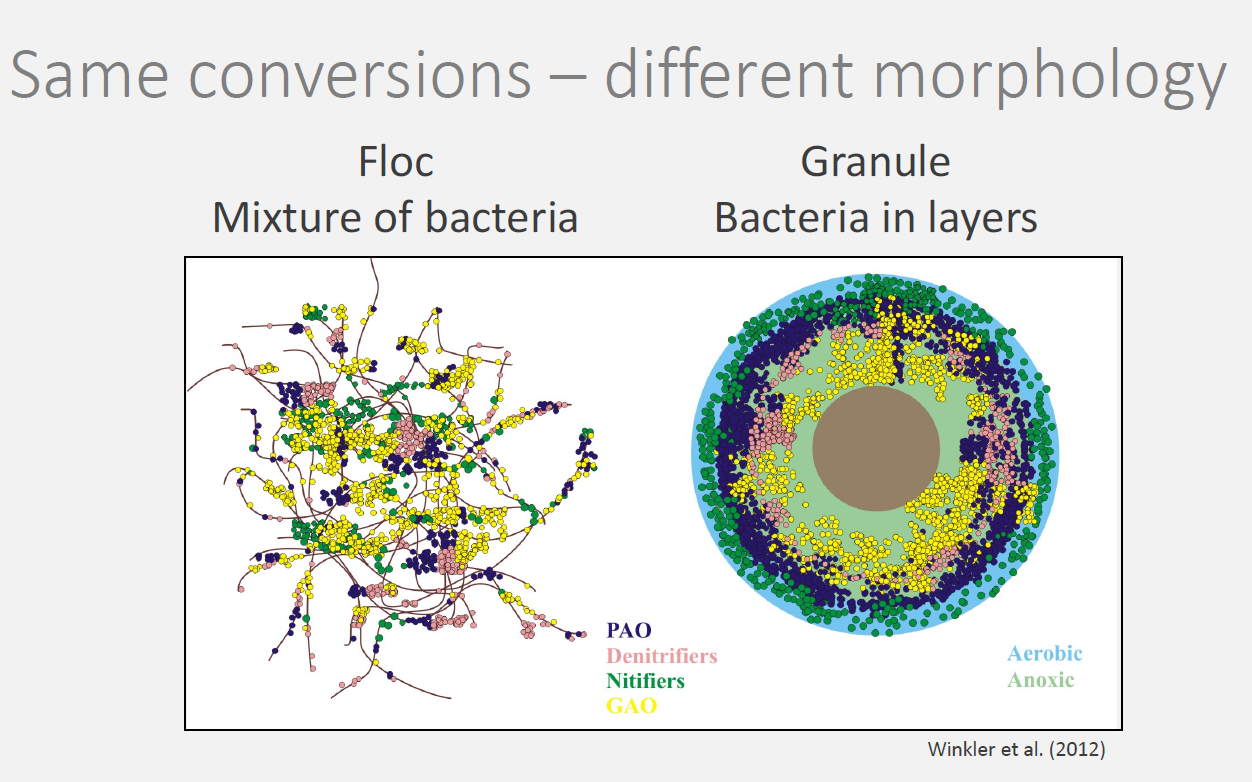
AGS technology can be considered an SBR 2.0 evolution of the sequencing batch reactor (SBR) process. It cultivates and utilizes the distinctive anaerobic, anoxic, and aerobic microbial zones that develop within the granules to remove COD and nutrients with lower aeration demand. It also utilizes the combined plug flow (space-wise during the fill stage) and batch (time-scale) reaction kinetics to maximize the treatment efficiency, taking advantages of substrate and oxygen gradient difference and saturation conditions. In front space and starting of time the biodegradable organic substrate penetrates inside granule depth, in aeration stage the oxygen concentration stays in the bulk liquid and shallower outer biofilm layer of granules. This spatial and temporal separation helps maintain complementary reaction zones and periods and can improve treatment efficiency when the cycle, granule structure, loading, and oxygen-transfer conditions are properly controlled.
AGS (Aerobic Granular Sludge) Technology Advantages/Benefits
- Lower footprint and space requriements
- Reduced energy consumption - almost lowest energy consumption besides MABR process
- Nutrient removal without chemicals - Simultaneous nitrification and denitrification, and able to achieve high level of N removal
- Phosphorous P removal - phosphate removal through release of phosphate in anaerobic stage and uptake in the aerobic reaction stage
- Tolerates wide swings in flow and organic loading
- No clarifier required (same as SBR)
- Better control over filamentous growth and settling problems
- Less equipment to service and maintain (compared to SBR: no decanter, no mixer)
- Existing conventional ASP (activated sludge process) or SBR plants can be converted to AGS to upgrade treatment capacity, possible to adapt to continuous operation
- No need to use bacteria or biofilm-supporting packing medium or solids-separation membranes (like in MBR plants)
Open the full-size aerobic granular sludge layers ↗
Wastewater Engineering Group provides AGS -aerobic granule sludge wastewater treatment plant and process design services, consulting, retroffing and new plants.
- AGS Plant Design
- AGS Process Design
- Pilot Test
- Startup and Commissioning
- Equipment Supply and Servicing
Open the full-size aerobic granular sludge process flow diagram ↗
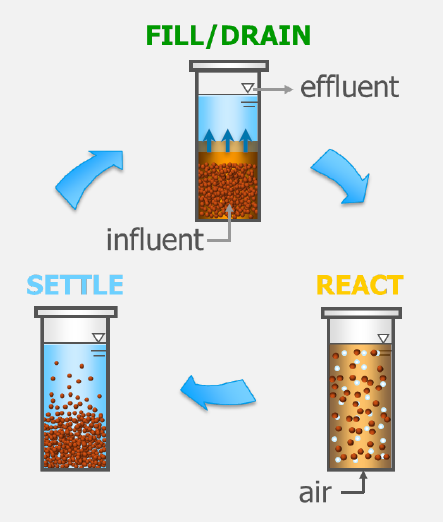
A process flow diagram of a typical AGS system is as shown above.
The processes inside the Sequencing Batch Reactor system include the following:
- Fill/Draw - raw sewage or wastewater is filled into the SBR tank, and it flows from bottom of the tank upwards to expel out the supernatant on top of the tank, which is the treated water from previous batch. Anaerobic hydrolysis takes place during this phase, and phosphate is released from the sludge into the bulk liquid. Readily biodegradable COD is mainly up-taken by the slow growing PAOs and GAOs bacteria for later usage.
- React - aeration process for the carbonaceous organic pollutant removal remained after the anaerobic stage, in the meantime, ammonia is removed by nitrification in the aerobic and anoxic layers of the aerobic granule by both filamentous suspended solids and the granule outer layer. Phosphate is up-taken by the PAOs (Phosphate accumulating organisms) and concentrated in the PAOs body thus removed from the bulk liquid together with the sludge removal.
- Settlement - settling of sludge after the react. The AGS granules settle very fast and all settle to the bottom of the tank within 5 minutes when the sludge granules are established. Some slow settling solids will remain on top layer of sludge blanket thus selected discharged as waste sludge.
Some major equipment used in Sequencing Batch Reactor System are:
- Pretreatment equipment: bar rakes, coarse and fine screens
- Fine bubble aeration systems: air blowers and diffusers
- Pumps for raw wastewater and treated effluent pumping
- AGS sludge thickening, dewatering and further treatment
- Effluent disinfection systems
Wastewater Engineering Group offers integrated AGS wastewater treatment plants /facility and process design, planning, for sewage disposal and water reuse.
AGS–SBR package plant pathway
AGS is commonly cultivated in an SBR operating environment, but the AGS page focuses on granule structure, microbial zones, settling behavior, and nutrient-removal biology. For the integrated operating sequence, see AGS–SBR Integrated Process; for the underlying conventional batch process, see SBR — Sequencing Batch Reactors.
In a true AGS displacement-fill arrangement, incoming water can enter at the bottom while treated supernatant leaves at the top, so separate mechanical decanting is not necessarily required. A packaged AGS–SBR arrangement may instead use a decanter when controlled batch withdrawal and a lower water depth are preferred. The selected hydraulics, granule-retention method, cycle timing, and sludge-wasting strategy should be verified against actual wastewater data.