MBR - Membrane BioReactors for Wastewater Treatment
MBR - Membrane Bioreactor Systems are no longer viewed as a novel process as it is used more and more in wastewater treatment applications all over the world.
Wastewater represents a water resource and its reuse can significantly reduce the demand for water supply. Membrane Bioreactor is an effective and economic treatment process for water reuse and reclamation. Advanced membrane technology development includes membrane bioreactors and multibarrier reclamation processes using dual membrane stages. A common water reclamation process is by integrating MBR and RO (Reverse Osmosis) to produce high quality product water for reuse.
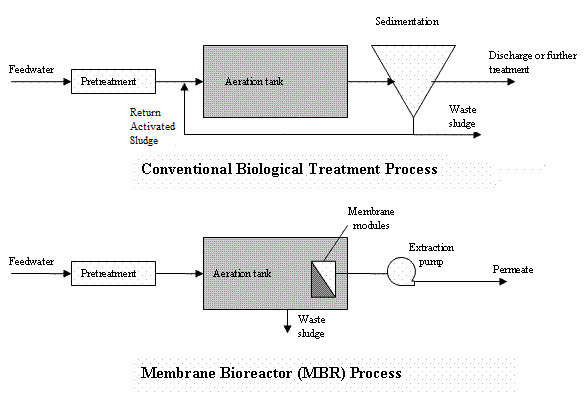
Compared with conventional activated sludge system, the membrane bioreactor system is much simpler, as shown below.
We supply a range of MBR Systems and modules to satisfy our customers' needs. By membrane configurations they can be classified as:
- Hollow Fibre MBR
- Evoqua Memcor mbr module
- Zennon ZeeWeed mbr module
- Mitsubishi Rayon membrane module
- Citic Memstar mbr module
- Plate and Frame MBR (Flat Sheet Membranes)
- Kubota mbr
- Hitachi membrane module - obselete and needs to use other compatible replacement modules e.g. WTA UNISOL MYTEX Modules
- Toray mbr module
- WTA UNISOL Mytex flat sheet backwashable membranes
- Huber
- Microdyn-Nadir/Mann+Hummel BioCel Membranes
By process configurations the MBR systems can be classified as:
- Submerged MBR
- Side Stream MBR (or external membrane)
For submerged MBR systems the Trans-membrane pressure is usually less than 0.5 bar (under vacuum pressure). The vacuum required for the mbr is usually from suctions pumps. Various types of pumps including centrifgal pump, gear pump, screw pump and helical rotor pumps can be used for this vacuum pumping purpose.
While for external membrane systems TMP of 1~4 bar is usual.
One typical MBR Process Flow Diagram is shown below. Raw wastewater usually pass through coarse screens and fine screens to remove particles that might possibly affect the downstream equipment and process. Membrane module can be immersed in the aeration tank itself or in a seprate membrane tank. Recirculation is utilized if denitrication is required for nitrogen nutrient removal.
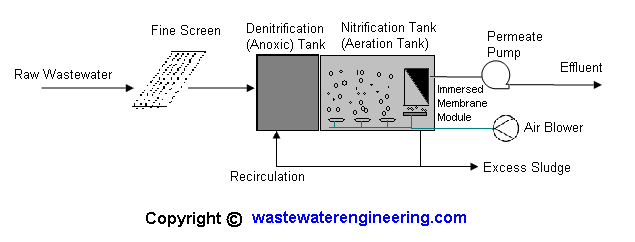
MBR process flow diagram showing screening, denitrification, aeration, membrane filtration, and permeate flow.
Raw wastewater -> Fine Screens -> Denitrification -> Aeration -> Filtration -> Permeate
MBR system's advantages include the following:
- almost complete solids and bacteria (Giardia and Crypto) removal;
- high effluent quality; modular design with good expandability;
- robustness in recovery resistant to upsets due to shock loadings or peak and fluctuating flows;
- sludge age or SRT (solids retention time) and hydraulic residence time (HRT) are controlled separately;
- less odor;
- sophisticated but yet simple controls.
Some of the disadvantages of MBR technology are:
- membrane fouling
- higher energy consumption to overcome trans-membrane resistance and to prevent fouling using aeration etc
- high cost of membranes
Wastewater Engineering Group's expertise in Membrane Bioreactor Systems range from treatability studies to retrofit of existing systems, we have vast design, operating experiences in MBR applications for sewage and industrial wastewater treatment.
Current MBR engineering notes
Reviewed October 2026. MBR is an established combination of biological treatment and membrane separation. The membrane can provide solids retention and clarification, but the design still depends on feed characterization, pretreatment, aeration, membrane flux, fouling control, cleaning, redundancy, and the final effluent objective. The historical material above remains useful as a process reference; the notes below frame the decisions that should be checked on a current project.
| Decision area | Current design question | What to verify |
|---|---|---|
| Feed and pretreatment | Can screens and upstream controls protect the selected membrane and maintain stable biology? | Peak flow, fats/oils/grease, fibers, grit, toxicants, salinity, temperature, and equalization needs. |
| Membrane operation | What flux, permeability, relaxation, backwash, and cleaning strategy is realistic for the wastewater? | Pilot or validated design data, transmembrane pressure trend, cleaning frequency, chemical compatibility, and replacement assumptions. |
| Biological process | How will carbon, oxygen, alkalinity, solids age, nutrient removal, and seasonal temperature interact? | Mass balance, aeration demand, nitrification/denitrification capacity, sludge production, and upset recovery. |
| Whole-plant energy | Does the proposed membrane configuration remain favourable after aeration, pumping, cleaning, air scour, sludge, and polishing are included? | Plant-wide energy balance rather than a membrane-only comparison. |
| Effluent and resilience | What happens during membrane isolation, cleaning, high-flow events, or a biological upset? | Train redundancy, bypass protection, storage, alarms, spare strategy, and final disinfection or reuse barriers. |
MBR selection boundary
MBR is a candidate when compact solids separation, high biomass retention, or reuse-oriented effluent quality justifies the additional membrane equipment and operating discipline. It should be compared with conventional activated sludge plus tertiary filtration, IFAS/MBBR, and other alternatives using the same flow, effluent, energy, residuals, land, and lifecycle-cost assumptions. EPA describes MBR advantages, applicability, design features, and design considerations in its Membrane Bioreactors Wastewater Management Fact Sheet.
MBR package-plant and alternative-process context
For packaged or modular MBR plants, Wastewater Engineering Group can support review of pretreatment, membrane-train arrangement, biological process control, air scour, cleaning-in-place, redundancy, permeate handling, and downstream disinfection or reuse barriers. The membrane route should be compared with SBR and AGS where compact batch biological treatment may be suitable; for anaerobic membrane treatment, see AnMBR.
A packaged MBR selection should verify feed protection, peak-flow storage, flux and permeability assumptions, fouling and cleaning frequency, train isolation, energy for aeration and pumping, membrane replacement, sludge handling, and the required effluent quality. These checks determine whether the added membrane equipment and operating discipline are justified for the project.